The global economy is currently passing through a phase that is becoming increasingly difficult to ignore. A few months ago, Chinese-Canadian academic and geopolitical analyst Professor Jiang Xueqin made a significant claim: he described the U.S. economy as a “Ponzi scheme”—a massive scam—sustained by capital from the Gulf Cooperation Council (GCC) countries. He warned that if this inflow of funds were to cease, the U.S. economy could collapse. Current developments suggest that Professor Jiang may be proven right much sooner than expected.
The US Economy: A ‘Ponzi Scheme’
Professor Jiang argues that the US economy is dependent on investments from Gulf nations, which channel their oil wealth into American tech companies—particularly those focused on AI and data center projects. This capital serves as the fuel that keeps US stock markets elevated. Jiang has explicitly stated that this entire dynamic rests on a financial bubble, which he characterizes as a “Ponzi scheme.”
“The American economy is a Ponzi scheme. It relies on investments from GCC (Gulf Cooperation Council) countries into AI and tech stocks.”
This statement becomes even more relevant now, as rising tensions in the Middle East threaten to disrupt oil supplies and cast a shadow over the investment capacity of the Gulf nations. Jiang had also predicted that the escalating conflict between Iran and the United States could cause this bubble to burst.
The Petrodollar System: A 50-Year-Old ‘Engine’ Begins to Falter
For the past 50 years, the world has operated on the petrodollar system. In 1974, a secret agreement was reached between the United States and Saudi Arabia: Saudi Arabia would sell oil exclusively in U.S. dollars, and in exchange, the U.S. would provide it with security. Subsequently, other OPEC nations followed suit.
The greatest advantage of this system was that every country in the world wishing to purchase oil was first required to deposit dollars, which were then invested in U.S. Treasury bonds (government debt). This was the “secret engine” that sustained demand for U.S. debt and enabled the United States to borrow at a low cost.
This engine is now sputtering:
- Zero oil imports from Saudi Arabia: In July 2026, the United States did not import a single barrel of oil from Saudi Arabia. This is the first time in 40 years that such a thing has happened! Restrictions in the Strait of Hormuz and attacks by Houthi rebels have blocked the routes for Saudi oil.
- A shift toward alternative currencies: Following the expiration of the US-Saudi agreement in 2024, Saudi Arabia has indicated the possibility of trading oil in currencies other than the US dollar—such as the yuan, the rupee, and the yen. Iran and Russia are already taking steps to move away from the dollar.
- BRICS and de-dollarization: The BRICS nations’ own payment system (BRICS Pay) is advancing rapidly. More than 90% of trade between Russia and China is now conducted in their respective currencies.
- Decline in the dollar’s share: The dollar’s share as a global reserve currency, which stood at 71% in 1999, has now fallen to just 57%.
Japan, China, and Britain are all selling off American debt.
Professor Jiang had also suggested that a major creditor like China might begin selling off U.S. Treasury securities, which would cause a stir in the American market. This prediction, too, appears to be coming true.
According to data from the U.S. Department of the Treasury, foreign investors sold a total of $721 million worth of U.S. bonds in June 2026.
- Japan—the largest holder of U.S. debt—sold $264 billion worth of bonds in June alone. The reason for this is to prevent the yen from falling.
- By selling $259 billion worth of bonds, China has reduced its holdings to their lowest level since September 2008 (the Lehman Brothers crisis). This is part of China’s long-term strategy to shift its reserves away from the dollar and into other assets.
- Britain sold $89 billion worth of bonds, a move that reflects the stance of hedge funds and major investors worldwide.
Scott Bessent’s ‘Forced Buyback’: Necessity or Strategy?
At a time when foreign buyers are stepping back, U.S. Treasury Secretary Scott Bessent has taken a surprising step. On August 19, 2026, the U.S. Treasury announced that it would double its buybacks of long-term bonds (maturing in 10 to 30 years). In other words, the U.S. government is buying back its own debt because other nations are unwilling to purchase it. Bessent told CNBC that these buybacks could exceed $4 billion per issue.
This move is being described in the market as a “band-aid on a bullet hole.” Evercore ISI analyst Krishna Guha termed it a “weak Operation Twist” that would have no lasting impact. The move did not even have a short-term effect on the market—the yield on 30-year bonds rose to 5.31%, marking a 19-year high.
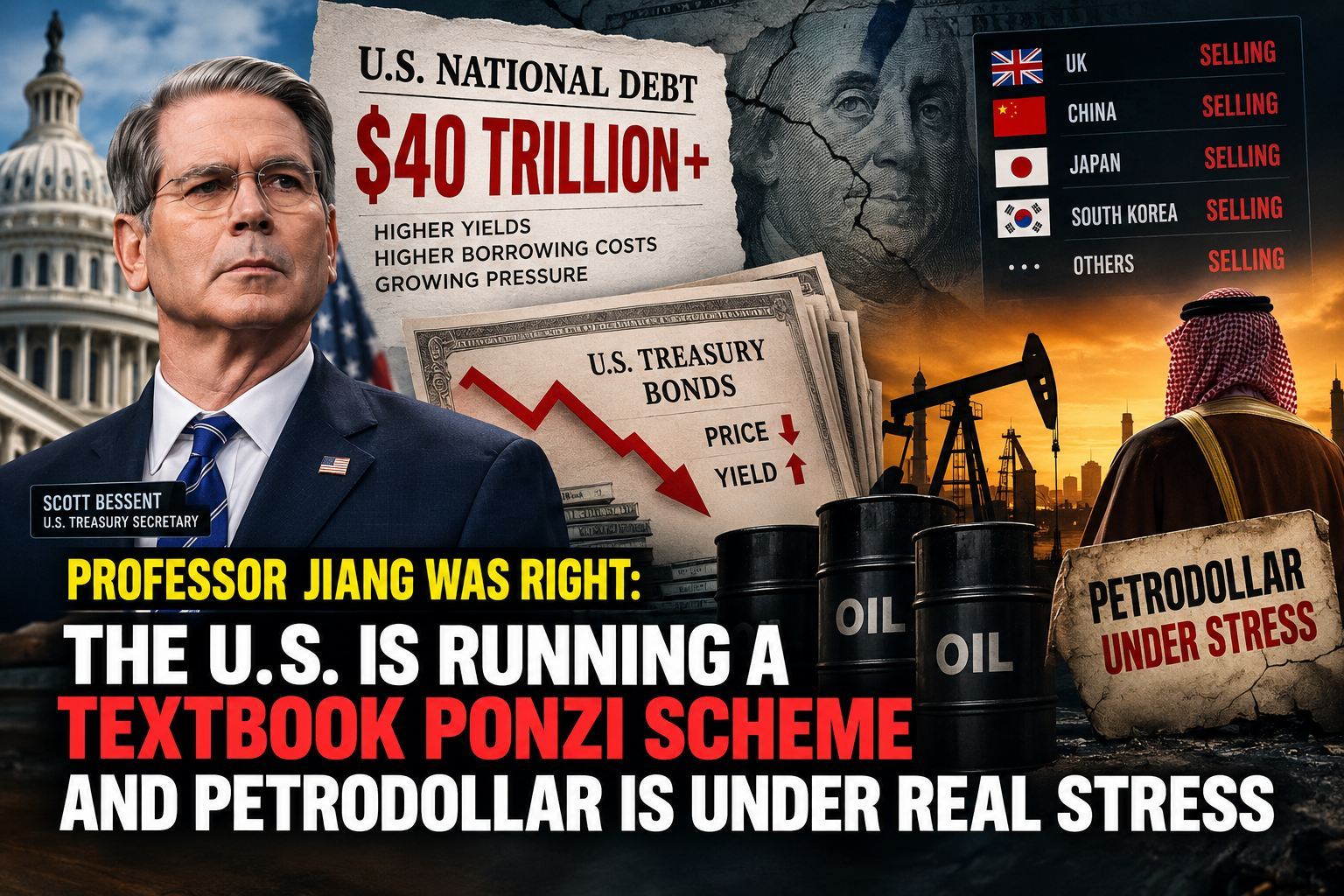
US debt crosses $40 trillion!
Amidst all this, US debt has surpassed the $40 trillion mark. This is $10 trillion more than the United States’ Gross Domestic Product (GDP). Every American citizen carries a debt of approximately $1.16 million.
What is the impact on India?
This crisis will also affect India:
Oil prices: Due to restrictions in the Strait of Hormuz, oil prices have crossed $100 per barrel. India, which relies on imports for more than 80% of its oil requirements, will face inflation and a current account deficit.
An opportunity for the rupee: The weakening of the petrodollar system could provide India with a chance to trade oil in rupees. Saudi Arabia is already open to accepting payments in rupees.
The threat of a global recession: If the US economy weakens, it will lead to a decline in global demand and have an adverse impact on India’s exports.
Conclusion: Is the ‘dream’ falling apart?
Professor Jiang’s prediction appears to be becoming reality rather than remaining merely a theory. Once the world no longer requires such large quantities of dollars to purchase oil, and major nations cease buying U.S. debt, it will become difficult for the United States to secure low-cost borrowing.
This is not a conspiracy. It is simply a matter of economics and mathematics—a game that is now exacting its price. The forced purchases by U.S. Treasury Secretary Scott Bessent are proof that the old system is breaking down. The question now is not whether change will occur, but rather how rapidly it will unfold and who will end up bearing the brunt of it.